


Getting started
The Grinder processes
The Grinder is a framework for running test scripts across a number of machines. The framework is comprised of three types of process (or program): worker processes, agent processes, and the console. The responsibilities of each of the process types are:
-
Worker processes
- Interprets test scripts and performs the tests.
Each worker process can run many tests in parallel using a number of worker threads.
- Interprets test scripts and performs the tests.
-
Agent processes
- Long running process that starts and stops worker processes as required.
- Maintains a local cache of test scripts distributed from the console.
-
The Console
- Coordinates the other processes.
- Collates and displays statistics.
- Provides script editing and distribution.
As The Grinder is written in Java, each of these processes is a Java Virtual Machine (JVM).
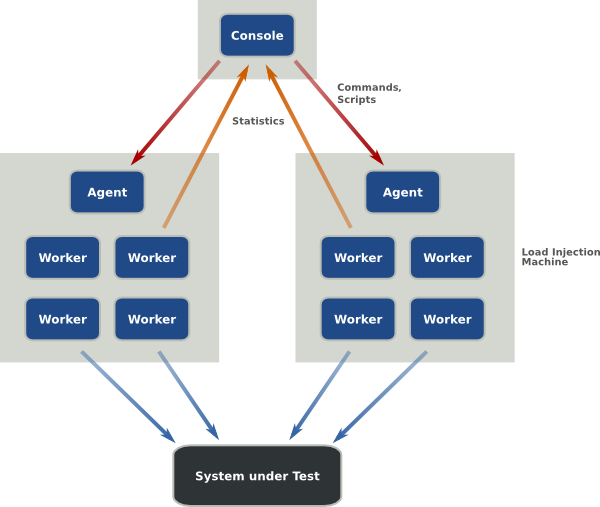
For heavy duty testing, you start an agent process on each of several load injector machines. The worker processes they launch can be controlled and monitored using the console. There is little reason to run more than one agent on each load injector, but you can if you wish.
Tests and test scripts
A test is a unit of work against which statistics are recorded. Tests are uniquely defined by a test number and also have a description. Users specify which tests to run using a test script. If you wish your scripts can report many different actions (e.g. different web page requests) against the same test, The Grinder will aggregate the results.
The script is executed many times in a typical testing scenario. Each worker process has a number of worker threads, and each worker thread calls the script a number of times. A single execution of a test script is called a run.
You can write scripts for use with the Grinder by hand. There are a number of examples of how to do this in the Script Gallery. See the Scripts section for more details on how to create scripts.
If you are creating a script to test a web site or web application, you can use the TCPProxy to record a browser session as a script.
Network communication
Each worker process sets up a network connection to the console to report statistics. Each agent process sets up a connection to the console to receive commands, which it passes on to its worker processes. The console listens for both types of connection on a particular address and port. By default, the console listens on port 6372 on all local network interfaces of the machine running the console.
If an agent process fails to connect to the console, or the grinder.useConsole property is false, the agent will continue independently without the console and automatically will start its worker processes. The worker processes will run to completion and not report to the console. This can be useful when you want to quickly try out a test script without bothering to start the console.
Output
Each worker process writes logging information to a file called host-n.log, where host is the machine host name and n is the worker process number.
Data about individual test invocations is written into a file called host-n-data.log that can be imported into a spreadsheet tool such as Microsoft ExcelTM for further analysis. The data file is the only place where information about individual tests is recorded; the console displays only aggregate information.
The final statistics summary (in the log file of each process) looks something like this:
Final statistics for this process:

              Successful
              Tests         Errors        Mean Test    Test Time
                                          Time (ms)    Standard
                                                       Deviation
                                                       (ms)

Test 0        25            0             255.52       22.52
Test 1        25            0             213.40       25.15
Test 2        25            0             156.80       20.81         "Image"
Test 3        25            0             90.48        14.41
Test 4        25            0             228.68       23.97         "Login page"
Test 5        25            0             86.12        12.53         "Security check"
Test 6        25            0             216.20       8.89
Test 7        25            0             73.20        12.83
Test 8        25            0             141.92       18.36
Test 9        25            0             104.68       19.86         "Logout page"

Totals        250           0             156.70       23.32
The console has a dynamic display of similar information collected from all the worker processes. Plug-ins and advanced test scripts can provide additional statistics; for example, the HTTP plug-in adds a statistic for the content length of the response body.
Each test has one of two possible outcomes:
- Success. The number of Successful Tests for that test is incremented The time taken to perform the test is added to the Total.
- Error. The execution of a test raised an exception. The number of Errors for the test is incremented. The time taken is discarded.
The Total, Mean, and Standard Deviation figures are calculated based only on successful tests.
How do I start The Grinder?
It's easy:
- Create a grinder.properties file. This file specifies general control information (how the worker processes should contact the console, how many worker processes to use, ..), as well as the name of the test script that will be used to run the tests.
- Set your CLASSPATH to include the grinder.jar file which can be found in the lib directory.
- Start the console on one of the test machines:
java net.grinder.Console
- For each test machine, do steps 1. and 2. and start an agent
process:
java net.grinder.Grinder
The agent will look for the grinder.properties file in the local directory. The test script is usually stored alongside the properties file. If you like, you can specify an explicit properties file as the first argument. For example:
java net.grinder.Grinder myproperties
The console does not read the grinder.properties file. It has its own options dialog (choose the File/Options menu option) which you should use to set the communication addresses and ports to match those in the grinder.properties files. The console process controls can be used to trigger The Grinder test scenario. Each agent process then creates child worker processes to do the work.
As the worker processes execute, they dynamically inform the console of the tests in the test script. If you start the console after the agent process, you should press the Reset processes button. This will cause the existing worker processes to exit and the agent process to start fresh worker processes which will update the console with the new test information.
Included below are some sample scripts, for both Unix/Linux and Windows, for starting grinder agents, the console, and the TCPProxy for recording HTTP scripts.
Windows
- setGrinderEnv.cmd
set GRINDERPATH=(full path to grinder installation directory)
set GRINDERPROPERTIES=(full path to grinder.properties)\grinder.properties
set CLASSPATH=%GRINDERPATH%\lib\grinder.jar;%CLASSPATH%
set JAVA_HOME=(full path to java installation directory)
PATH=%JAVA_HOME%\bin;%PATH%
- startAgent.cmd
call (path to setGrinderEnv.cmd)\setGrinderEnv.cmd
echo %CLASSPATH%
java -classpath %CLASSPATH% net.grinder.Grinder %GRINDERPROPERTIES%
- startConsole.cmd
call (path to setGrinderEnv.cmd)\setGrinderEnv.cmd
java -classpath %CLASSPATH% net.grinder.Console
- startProxy.cmd
call (path to setGrinderEnv.cmd)\setGrinderEnv.cmd
java -classpath %CLASSPATH% net.grinder.TCPProxy -console -http > grinder.py
Unix
- setGrinderEnv.sh
#!/usr/bin/ksh
GRINDERPATH=(full path to grinder installation directory)
GRINDERPROPERTIES=(full path to grinder.properties)/grinder.properties
CLASSPATH=$GRINDERPATH/lib/grinder.jar:$CLASSPATH
JAVA_HOME=(full path to java installation directory)
PATH=$JAVA_HOME/bin:$PATH
export CLASSPATH PATH GRINDERPROPERTIES
- startAgent.sh
#!/usr/bin/ksh
. (path to setGrinderEnv.sh)/setGrinderEnv.sh
java -classpath $CLASSPATH net.grinder.Grinder $GRINDERPROPERTIES
- startConsole.sh
#!/usr/bin/ksh
. (path to setGrinderEnv.sh)/setGrinderEnv.sh
java -classpath $CLASSPATH net.grinder.Console
- startProxy.sh
#!/usr/bin/ksh
. (path to setGrinderEnv.sh)/setGrinderEnv.sh
java -classpath $CLASSPATH net.grinder.TCPProxy -console -http > grinder.py